

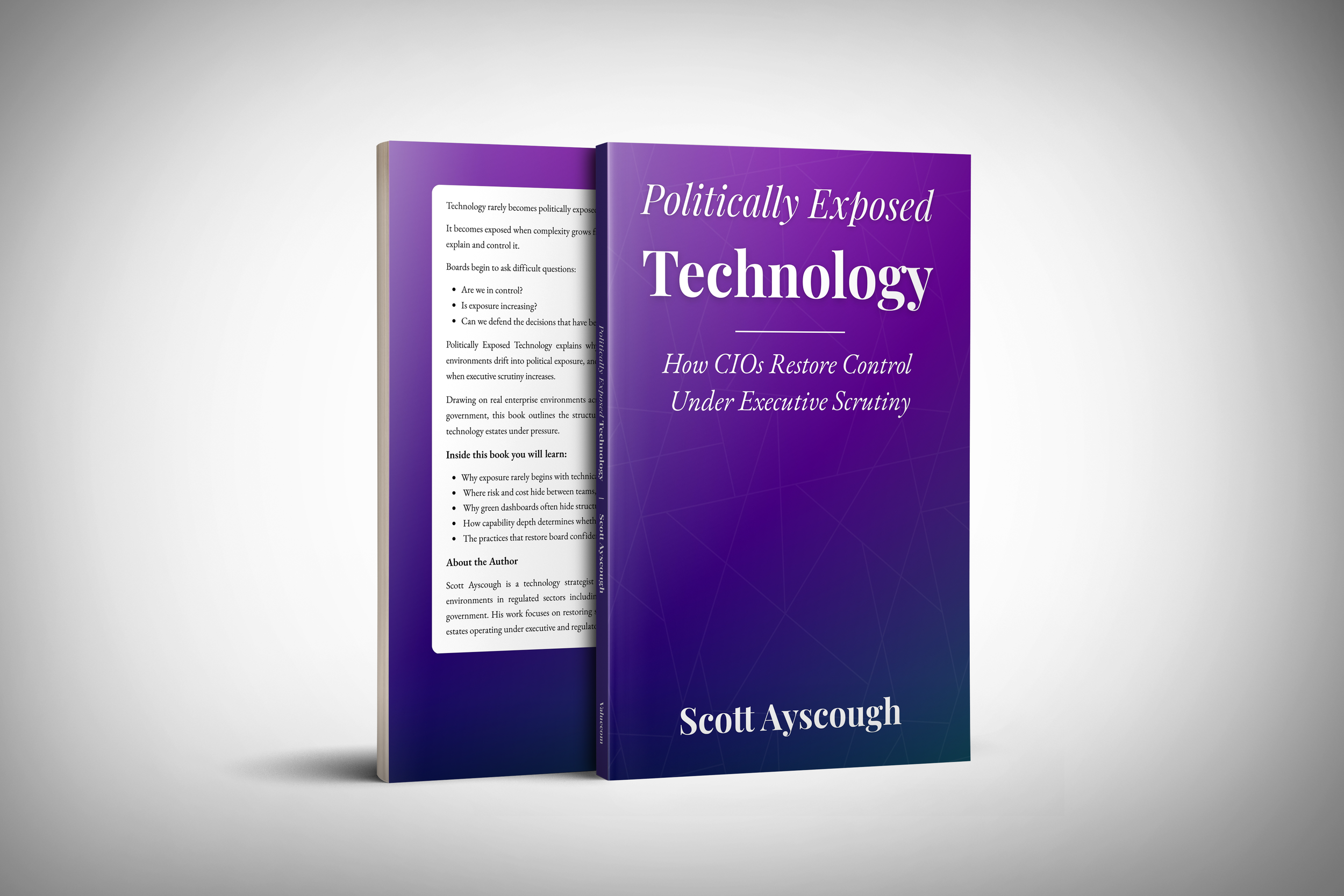
Politically Exposed Technology
How CIOs restore clarity and control when complex technology programmes come under executive scrutiny.
Insights from complex enterprise and national infrastructure technology environments.
About the author_
Scott Ayscough is Founder and Managing Director of Valuecom and a former member of the Royal Signals.
He has worked across complex enterprise and national infrastructure technology environments within regulated sectors including healthcare, utilities, aviation and government.
After leading and recovering large scale transformation environments, often without established organisational frameworks in place and repeatedly encountering the same structural problems, he began examining the operational conditions, governance disciplines and leadership structures that consistently enabled transformation recovery, delivery stability and organisational control.
This work led to the development of the Valuecom Enterprise Transformation Delivery Framework, a structured model designed to enhance political alignment, governance authority, commercial structure and architecture integrity across complex transformation environments.
The framework is now used by Valuecom to help organisations accelerate, stabilise and de risk enterprise transformation delivery while maintaining operational control and leadership confidence.

LinkedIn insight series_
The LinkedIn insight series explores the operational realities behind complex enterprise technology and transformation environments.
The series focuses on the structural conditions that commonly create delivery instability, governance fragmentation and executive exposure across large-scale organisations.
Topics explored include:
Transformation recovery and operational stabilisation
Governance failure patterns in enterprise delivery
Supplier complexity and accountability breakdown
Operational resilience under executive scrutiny
Technology exposure in regulated environments
Delivery confidence and leadership stability
Enterprise recovery capability and control
Sustaining transformation outcomes at scale
The insights are drawn from real-world enterprise delivery environments across healthcare, utilities, aviation, logistics, government and national infrastructure sectors.
The focus is not theory.
It is understanding how organisations maintain operational control, delivery stability and leadership confidence as complexity increases.

Context_
Large technology estates rarely fail suddenly. More often confidence erodes gradually as complexity becomes harder to explain, govern and control.
Dashboards remain green.
Programmes appear active.
Yet leadership conversations begin to change.
Boards start asking simpler questions:
Are we in control
Is exposure increasing?
Can this be defended publicly?
When those questions cannot be answered clearly, technology becomes politically exposed.
Why technology becomes politically exposed_
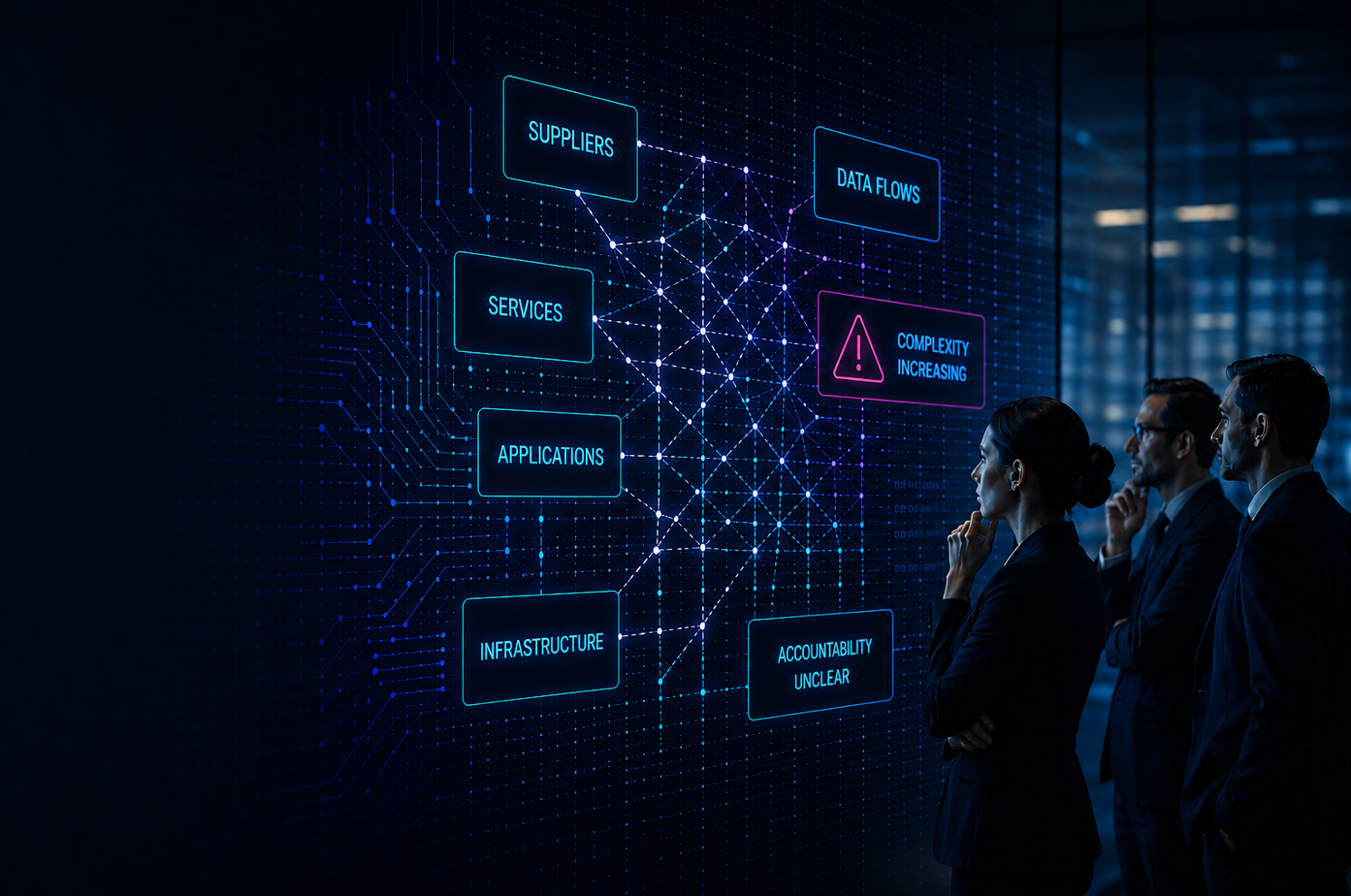
In complex technology environments exposure rarely appears overnight. Instead it emerges through a combination of structural factors:
Fragmented supplier ecosystems
Increasing architectural complexity
Unclear accountability between services
Programme delivery pressure
Regulatory scrutiny
By the time scrutiny intensifies, the underlying exposure has usually been developing for months.
Understanding these structural patterns is critical for maintaining operational and leadership stability.
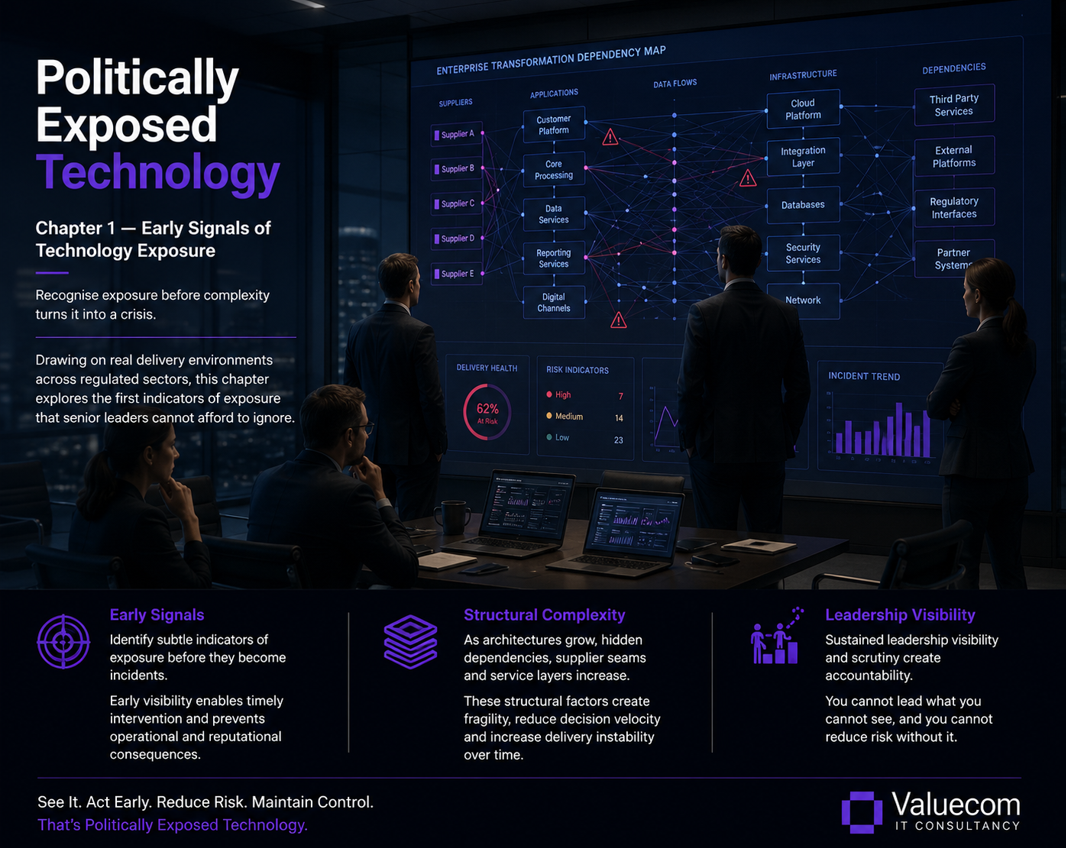
If you would like to explore these ideas in more detail, the opening chapter of Politically Exposed Technology is available to download.
The chapter examines the early signals that complex technology environments are becoming politically exposed and why organisations often misdiagnose the underlying causes.
It introduces the structural patterns that appear repeatedly in large enterprise and national infrastructure technology programmes.
Read the opening chapter_
Valuecom enterprise transformation delivery framework_
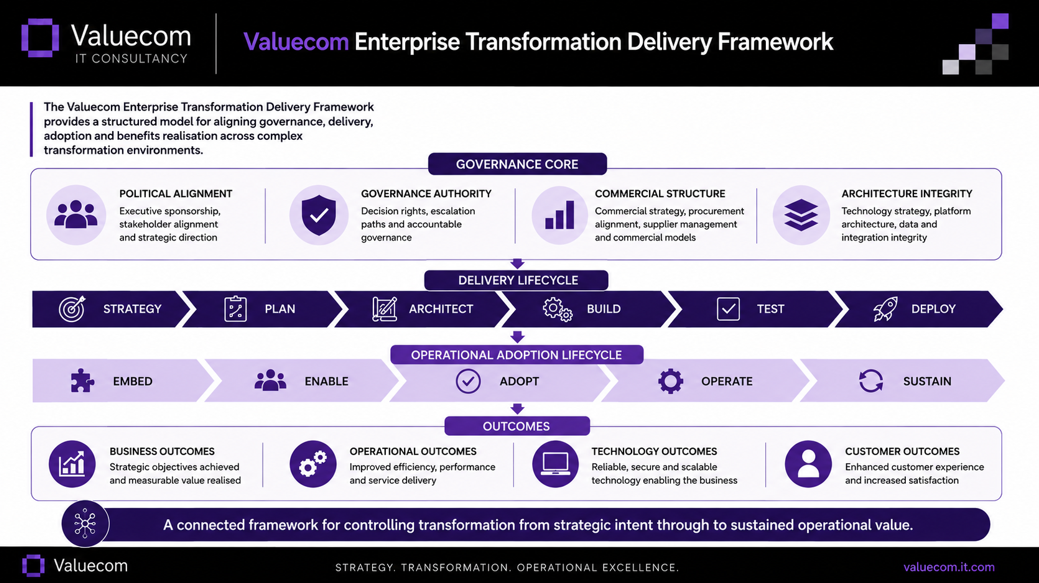
The Valuecom Enterprise Transformation Delivery Framework provides a structured enterprise model for aligning governance, delivery, operational adoption and benefits realisation across complex transformation environments.
Developed through large scale enterprise transformation and recovery environments, the framework establishes the structural disciplines required to maintain operational control, leadership confidence and delivery stability as organisational complexity increases.
The framework integrates four core control disciplines:
Political alignment_
Executive sponsorship, stakeholder alignment and strategic direction must remain continuously aligned throughout transformation delivery.
Large scale programmes rarely fail purely through technology. More often, instability emerges when organisational priorities, sponsorship alignment and strategic intent begin to diverge.
Governance authority_
Clear governance authority creates decision velocity, escalation clarity and accountable operational control.
The framework establishes structured governance pathways that reduce ambiguity, strengthen accountability and maintain leadership confidence during periods of delivery pressure.
Commercial structure_
The framework addresses the operational seams between suppliers, services and delivery responsibilities where accountability fragmentation commonly develops.
Architecture integrity_
Sustained transformation stability depends on maintaining coherent technology, platform, integration and operational architecture.
As complexity increases across cloud platforms, services, data flows and operational dependencies, maintaining architectural integrity becomes critical to sustaining operational control.
Valuecom_
Valuecom helps enterprise organisations regain control across complex technology and transformation environments.
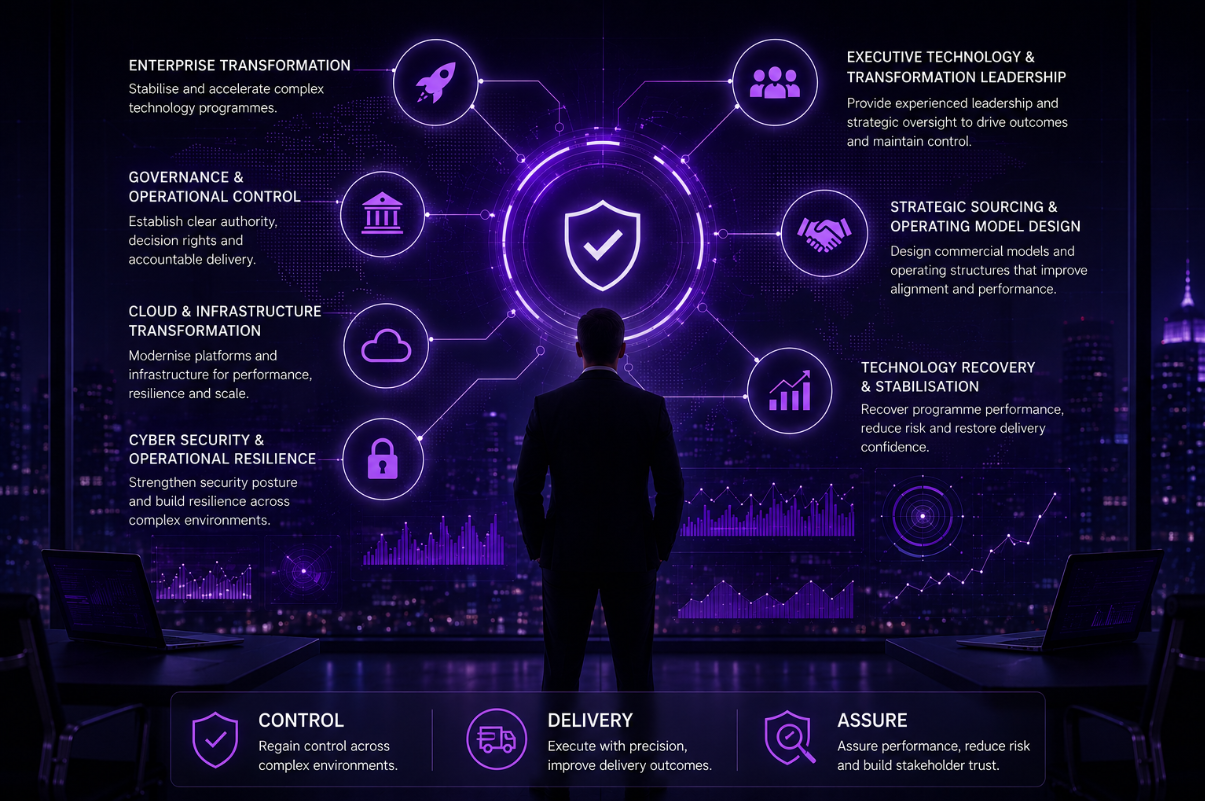
Using the Valuecom Enterprise Transformation Delivery Framework, we align governance, delivery, operational adoption and architecture integrity to help organisations accelerate, stabilise and de risk large scale transformation programmes.
Our work focuses on:
Enterprise transformation delivery
Transformation governance and operational control
Cloud and infrastructure transformation
Cyber security and operational resilience
Executive technology and transformation leadership
Strategic sourcing and operating model design
Technology recovery and stabilisation
Valuecom works across regulated, nationally significant and operationally complex environments where delivery stability, leadership confidence and operational control are critical to organisational success.